
The Case for Low Dose CT Lung Screening
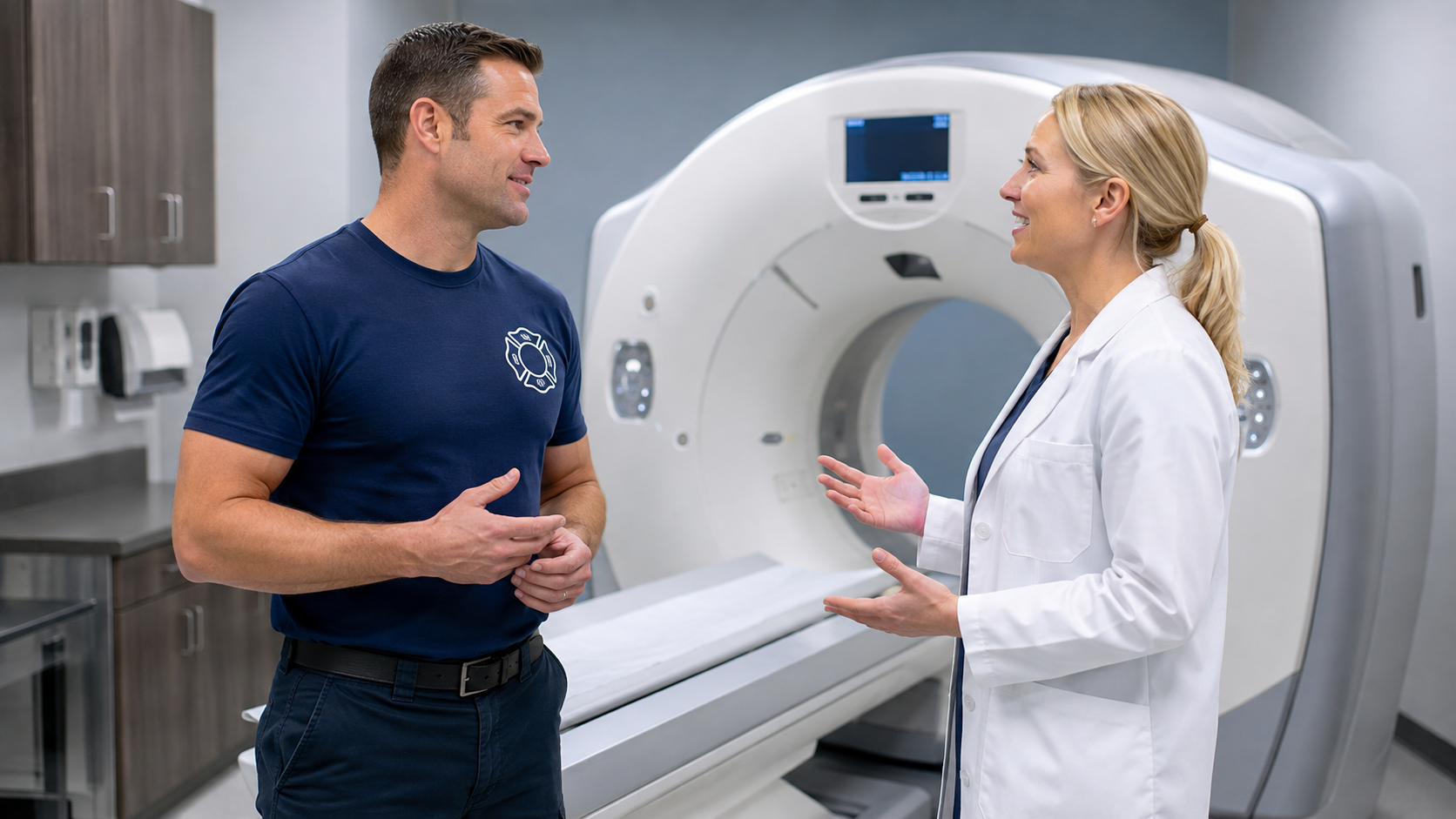
Improving Lung Cancer Screening in Firefighters and Their Communities
Many fire departments still screen asymptomatic firefighters with a chest radiograph — despite published guidance against the practice.
Why the Chest X-Ray Persists
The chest x-ray is familiar, inexpensive, and easy to schedule — which is why it remains embedded in annual assessment cycles years after the guidance moved on.
NIOSH advised against routine screening chest x-rays in 2014 due to unnecessary radiation exposure. NFPA 1582 was subsequently modified from an annual chest x-ray to a baseline study repeated as medically indicated.
What the Evidence Shows
The National Lung Screening Trial — more than 50,000 participants — found a 20% relative reduction in lung cancer deaths with LDCT compared with chest radiography. LDCT is roughly ten times more likely than a chest x-ray to detect non-calcified nodules, at about 22% of the effective radiation dose of a standard CT.
Detection timing is the whole argument. One-year survival for stage IV lung cancer is 15–19%. For stage I, it is 81–85%.
One Case Makes the Point
A cross-sectional study screened 350 Arizona firefighters with 20-plus years of service using LDCT. It found that five-year chest x-ray protocols were not detecting pulmonary lesions with adequate sensitivity. Among the participants was an asymptomatic 38-year-old whose chest x-ray had been read as normal two years earlier; the LDCT found stage IIIB lung cancer. That study’s author now recommends beginning annual LDCT screening at age 40.
What Else the Scan Catches
LDCT also visualizes coronary artery calcification, which correlates directly with cardiovascular death risk — and independent of every other known risk factor, moderate or severe calcification predicts higher CV mortality. That makes the scan most valuable in exactly the members who look lowest-risk on paper.
The Barriers — and the Answer
Fire departments consistently identify two obstacles to LDCT: access and cost. Neither is a clinical objection — they are logistical ones, and logistics can be solved.
On Duty Health addresses both through partnerships with local radiology clinics, so members are screened close to home at a negotiated rate, on a schedule built around the department’s assessment cycle rather than the other way around.

by Kristin Batla, DMSc, PA-C
Chief Medical Officer